
Table Mountain is home to around 1 500 indigenous plant species within a 57km² area – that’s more than the entire United Kingdom of well over 240 000km²! Due to its staggeringly high biodiversity (“species richness” or the number of species occurring there), Table Mountain is a major tourist attraction and is rightfully regarded as one of the New 7 Natural Wonders of the World.
This article will highlight 21 of Table Mountain’s most remarkable plant species, including what makes them so special and how to see them.
Endemic plantlife of Table Mountain
Many species found on Table Mountain are endemic, meaning that they occur only here and nowhere else in the world. The vast majority of these species grow in Fynbos, a local shrubland vegetation type. Fynbos comprises four main groups of plants: Proteas (Proteaceae), Ericas (Ericaeae), Restios (Restionaceae), and Bulbs (Geophytes). It is no wonder that Table Mountain is a hotspot for hikers and botanists alike in search of unique and exciting flowers.
With so many species here, it is unsurprising that some of them often get confused with one another since they can be rather tricky to tell apart. When observing plants, it is always ideal to take note of as many details as possible. This includes what the flowers look like from the top and the side, the leaves, stems, and full plant in its natural habitat – especially when photographing them for later identification. Naturally, the more clues you have the easier identifying the species becomes.
So without any further ado, here are some of Table Mountain’s most precious flowers and how to see them.
21 native plants to look out for on Table Mountain
These are some of the most striking and identifiable native plants to look out for on Table Mountain!
Red Disa
Disa uniflora
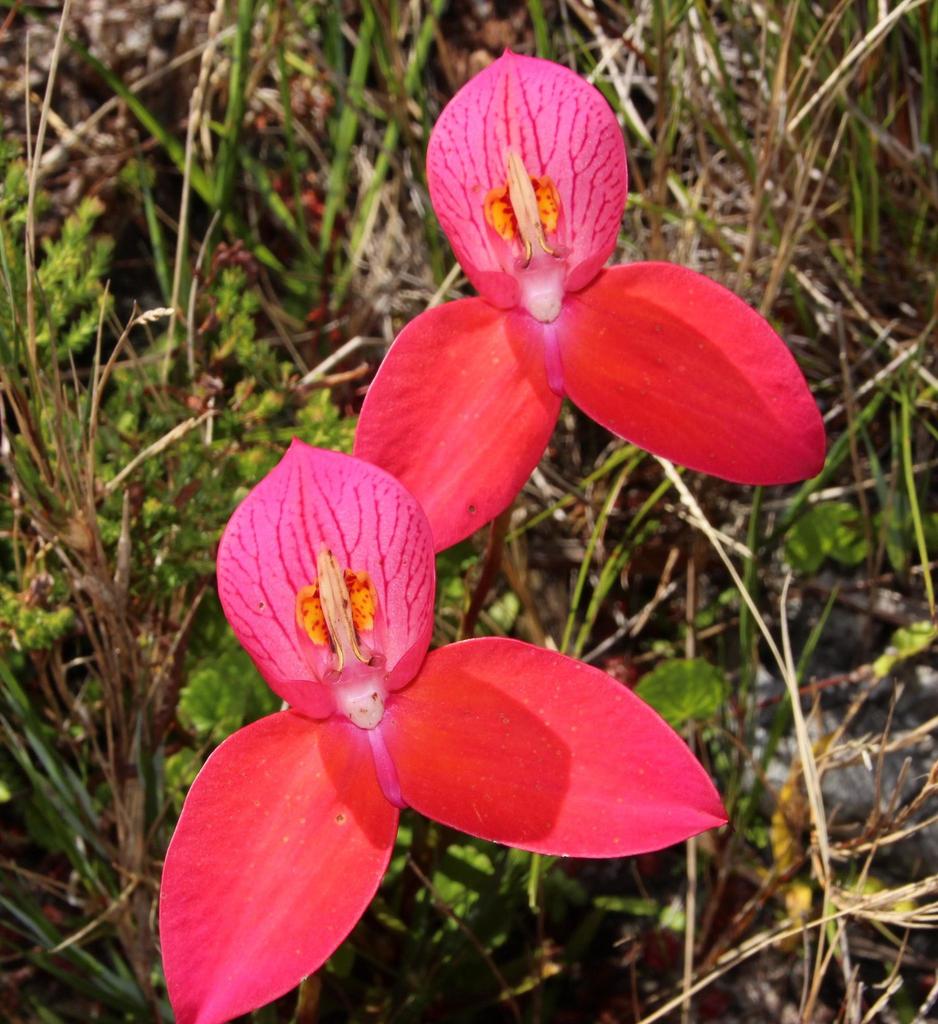
Photo by Tony Rebelo
Any South African will instantly recognise the Red Disa for its selection as the Western Province Rugby emblem. It also appears on the logos of several other sports teams and clubs. This stunning bright red orchid is perhaps the most well-known of its kind – and it’s no secret why. There is no other flower quite like it.
The Red Disa is not only fairly common on Table Mountain, but actually has a much broader distribution range spanning all the way from the Cederberg to Hermanus in the southwestern Cape where it loves to sit on the banks of cool streams and waterfalls.
What is perhaps most astounding about the species is the fact that it is pollinated exclusively by the Table Mountain Pride Butterfly (Aeropetes tulbaghia) and is thus completely dependent on the butterfly to fulfil its pollination duties.
Drip Disa
Disa longicornu
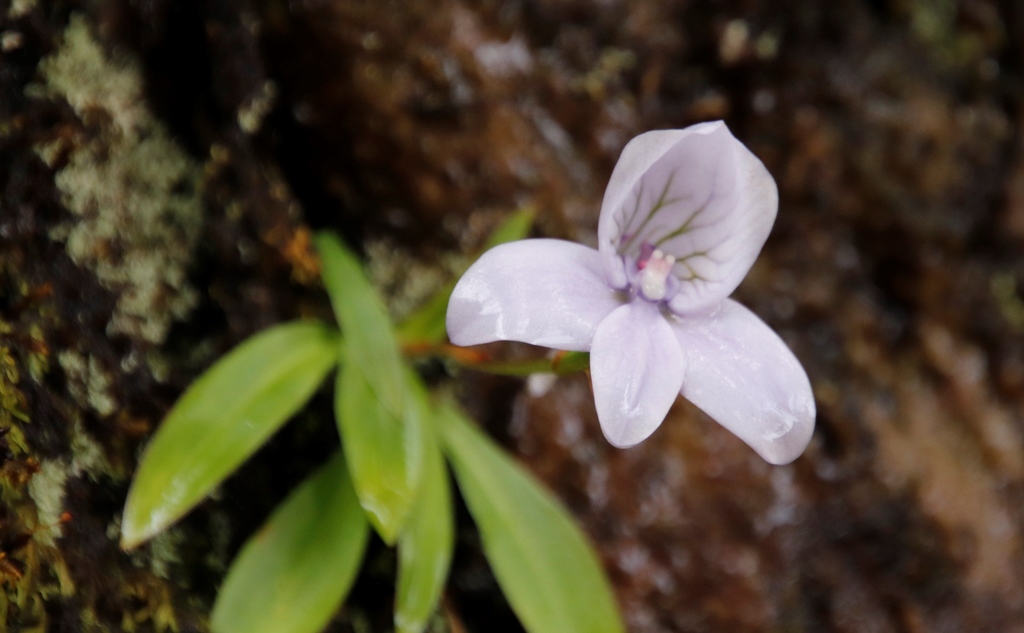
Photo by Tony Rebelo
As a close relative of the Red Disa, the blue Drip Disa is arguably one of Table Mountain’s most fascinating flowers. Occurring in small local clumps, each plant bears just one sizeable “gunmetal blue” flower with green veins appearing on the middle sepal.
The Drip Disa shows off these stunning flowers in December and January. The species is a fond lover of damp mossy rock ledges – always found on South-facing cliffs which get fed a constant supply of moisture by the southeasterly clouds. This is where it gets its common name “Drip Disa” from.
It has a small distribution range from Table Mountain to the Hottentots-Holland Mountains. Unfortunately, the species is under heavy threat from illegal collecting and picking which has caused a significant decline in the species’ numbers in recent years. This has resulted in the Drip Disa being Red Listed as Vulnerable to extinction.
Peninsula Conebush
Leucadendron strobilinum
Photos by Tony Rebelo
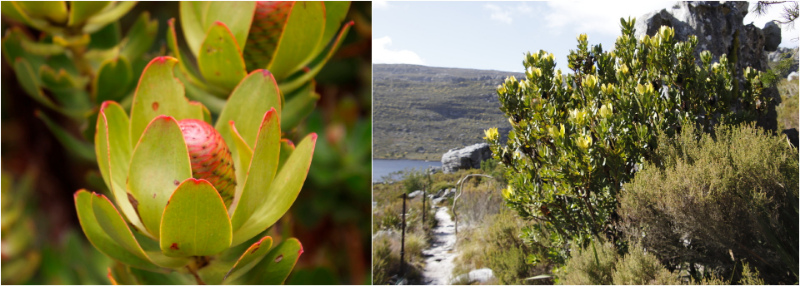
Found only on the northern half of the Cape Peninsula – mainly on Table Mountain – the Peninsula Conebush belongs to the Protea family (Proteaceae). In its natural habitat, it is a large woody shrub with shiny green-leathery leaves that are often tipped in red or pale yellow.
The species is dioecious, meaning that it has separate male and female plants. The female plant bears a rock-hard ovoid cone that contains the seeds within. These cones are only stimulated to release their seeds after wildfires in order to encourage successful germination. As most parts of Table Mountain have gone for many years without fire, it is easy to spot the old plants standing out in the landscape. Sometimes the woody branches are even covered in tufts of grey lichen. The male plants have much smaller yellow flowering structures that release the pollen.
Because the Peninsula Conebush relies on wildfires for new growth, unfortunately the recent lack of wildfires has partly resulted in the species being Red Listed as Vulnerable (VU) to extinction by SANBI’s Threatened Species Programme. The Peninsula Conebush is also threatened by invasive alien plant species which compete with it for crucial resources like water and space.
In Latin, “dendros” means “tree”, while in Greek “strobilos” means “cone” – hence its scientific name: Leucadendron strobilinum.
Devil’s Heath
Erica abietina subsp. diabolis
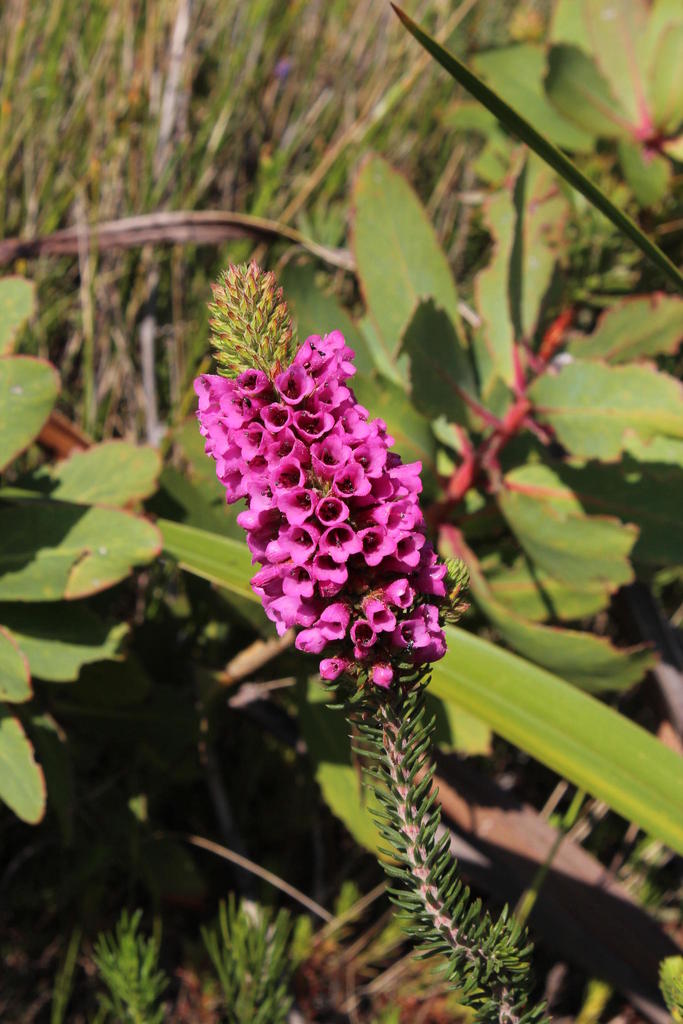
Photo by Tony Rebelo
The Devil’s Heath gets its name from Devil’s Peak, since it only occurs from here to the lower saddle where it joins up with Table Mountain. This is suggested in the subspecies name “diabolis” – Latin for “devil”.
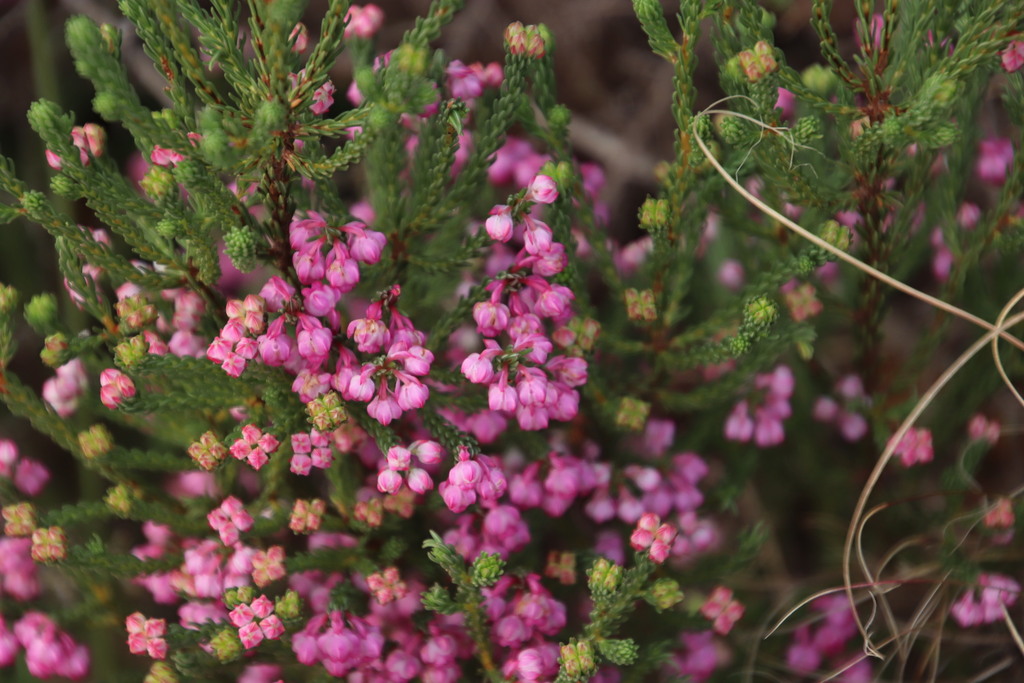
The species shows off dense bunches of pretty pink flowers on small shrubs from June to August. Unfortunately, it is believed that its population is slowly decreasing and so it has been Red Listed as Critically Endangered (CR). It is found within such a small area that a single major event such as an intense wildfire could potentially harm the population beyond recovery – that is if the plants have not had enough time to reach full maturity since the last wildfire. Despite Fynbos relying on fire for its survival, sometimes too frequent fires can be more damaging than helpful.
You can grow some of these endemic species yourself with Eri-Kah van Breda’s guide to fynbos gardening!
Berry Heath
Erica baccans
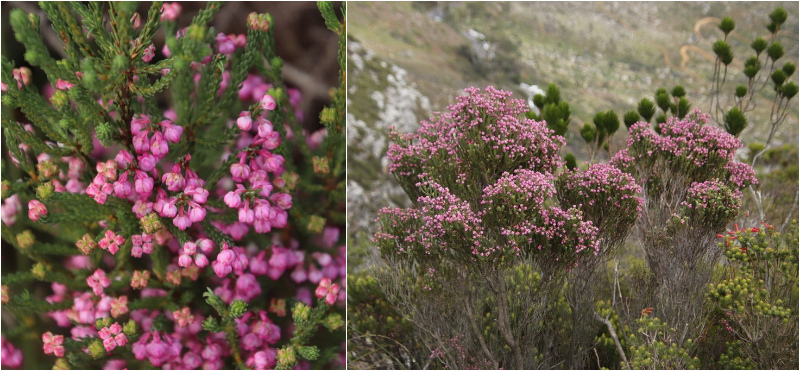
Photos by Tony Rebelo
The Berry Heath is yet another Cape Peninsula endemic found across the entire Cape Peninsula from Signal Hill to Cape Point. However, it is perhaps most common on the lower sunny slopes of Lion’s Head, Table Mountain, and Devil’s Peak.
As a tall sturdy shrub, the Berry Heath becomes engulfed in small rose-pink flowers mainly between summer and winter. Some hikers have noted the similarities between these small globular flowers and berries, and so this is how the Berry Heath got its name. From the scientific name Erica baccans, “baccans” translates to “berry” in Latin.
With an astounding 104 species of Erica on the Cape Peninsula alone, identifying them can get a bit overwhelming at times. Be that as it may, the general robust nature of the woody Berry Heath shrubs and their pink berry-like flowers are quite distinct in comparison to other similar Erica species.
Heady Capegorse
Aspalathus capitata
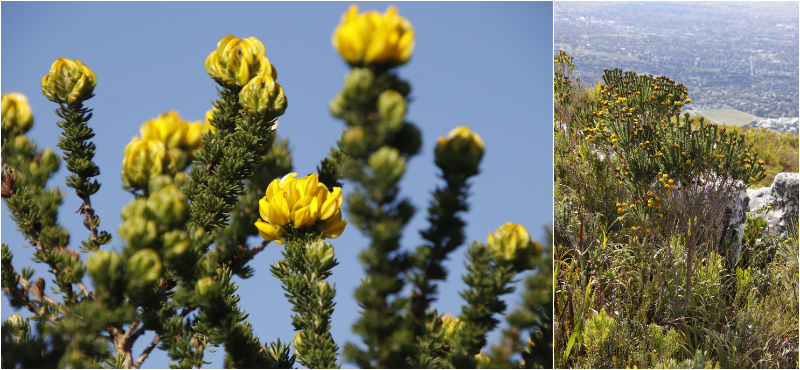
Photos by Tony Rebelo
The Heady Capegorse often finds itself standing out tall above the rest of the Fynbos, as it should. It is a member of the Pea family (Fabaceae) and during its peak flowering season it’s hard to miss the vibrant yellow balls of flowers suspended atop the tall green shrubs. This is mainly from September to October, but sometimes continues throughout late summer and autumn.
The Heady Capegorse only occurs on sunny sandstone slopes from Table Mountain to Silvermine and is quite rare to come across. Thus, it is always a treat when one does stumble upon it.
It is Red Listed as Vulnerable due to past threats such as competition for resources with invasive alien plants like Gums (Eucalyptus), Pines (Pinus), and Australian Wattles (Acacia), which have led to a slight population reduction over the years. This means that it may face the threat of extinction sometime in the future if it is not monitored very carefully and frequently. However, as it stands, the species is not immediately threatened and several healthy populations still remain.
Sticky Diamondeyes
Staavia glutinosa
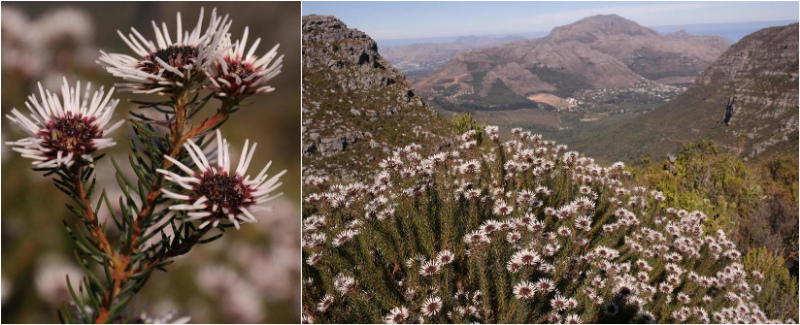
Photos by Nick Helme
This extra terrestrial-looking plant looks like something straight from Mars! As with most Fynbos species, the Sticky Diamondeyes flower heavily relies on wildfires to stimulate new regrowth. Since parts of Table Mountain have gone for many years without fire, this species is unfortunately very rare. It is found only on Table Mountain and nowhere else.
Here it prefers to grow on damper South-facing slopes that do not receive as much sunlight. It is currently known from no more than five different locations on Table Mountain and is an absolute treasure to come by. Luckily it does not follow a particularly strict flowering routine and so it can be spotted during most spring and summer months.
Peninsula Sissy
Brachysiphon fucatus
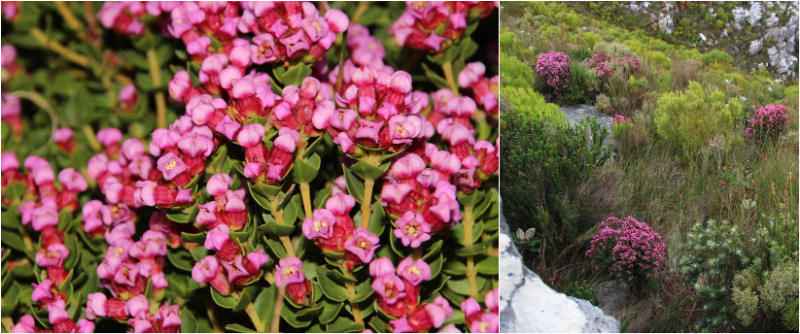
Photos by Tony Rebelo
As its name suggests, the Peninsula Sissy is a Cape Peninsula endemic and although it is rather rare across most of its range, it is far more common on Table Mountain than on any other part of the Cape Peninsula. On Table Mountain, it tends to enjoy more shaded rocky slopes and ridges (for the most part, at least).
While flowering, generally from June to October, it lights up the landscape with its countless bright pink flowers. The flowers are characterised by four small petals and completely shower the small shrubs in luminous pink. Due to its colour, the species is extremely easy to spot when in flower and has a reputation for – quite literally – brightening up any hiker’s day!
Peninsula Sundew
Drosera cuneifolia