

The United Nations has declared 2021–2030 the Decade on Ecosystem Restoration. The aim of this initiative is to “prevent, halt and reverse the loss of nature”. One way to “reverse” the loss of nature is to restore habitats that have been degraded or converted to another form of land use, such as old farms or plantations that are no longer in use. This is done by reintroducing native plant species and returning an ecosystem to its original state.
While the UN Decade project is ambitious in its global scope, each individual action that contributes to restoring degraded ecosystems, no matter how small, plays an important part in achieving this vision. This article highlights some of the restoration sites across the biodiverse city of Cape Town, all of which are open to the public to visit and to provide their volunteering services.
The uniqueness of Cape Town’s biodiversity
Cape Town is one of the most biodiverse cities in the world, meaning it has a very high number of plant and animal species for an urban area. This is largely a result of the city being located near the centre of the Cape Floristic Region, one of only six floral kingdoms in the world.
There are around 3 400 indigenous plant species within the city limits. This figure is often quoted in relation to the UK, which has about 1 200 plant species, but even compared to other diverse cities, Cape Town is remarkable. The city also hosts approximately 370 bird, 100 mammal and 104 reptile and amphibian species.
An important aspect of biodiversity is endemism, which refers to organisms that occur only in one area and nowhere else. Endemic species are often the focus of conservation projects, because they are more vulnerable to habitat loss and degradation by virtue of their limited ranges. Of the 3 400 indigenous plants, around 190 are found nowhere else but the city of Cape Town. If they are lost within Cape Town, they are lost in the wild forever.
Unfortunately, dozens of species of plants and animals of Cape Town have already faced such extinction, and the Cape provinces have one of the highest plant extinction rates in the world. Other species would likely have also disappeared if not for one of the important methods used by conservationists – ecosystem restoration.
Erica pyramidalis var. pyramidalis, a Cape Flats endemic Erica species last seen in 1907. Photo uploaded to iNaturalist by Tony Rebelo.
Ecosystem restoration in Cape Town
The ultimate goal of ecosystem restoration is to re-establish ecological processes that have been lost. It is not always possible to return a habitat to its original, pre-modern state, because many of the factors that were once present are now gone.
For example, the herbivores that previously roamed the Cape peninsula are now mostly absent, such as quagga, hippos and large antelope. In a similar vein, wildfires are now quickly extinguished because they pose threats to properties and life.
In some areas it is possible to closely mimic these past processes, but in others it is not. Different areas therefore require different restoration objectives.
Lowland Fynbos at Kenilworth Racecourse Conservation Area gives us insight into how the vegetation of the Cape Flats looked before development. Photo from KRCA Facebook Page.
How do we restore ecosystems?
In general, the process of restoration involves re-introducing indigenous plant species that have disappeared from an area or whose populations have significantly declined. In Fynbos habitats, this is accompanied by controlling alien plant invasions, and conducting prescribed burn cycles. The hope is that the system will then become self-sustaining, in the sense that indigenous plants will successfully produce seeds and seedlings, and native animals will utilise these areas.
In the Cape, ongoing maintenance and management will always be required to manage invasive species being transported from outside, so restored areas here can never be 100% self-regulating.
The scientific field of ecological restoration is relatively young, and much pioneering research has taken place in restored nature reserves around Cape Town. This has included determining which species to reintroduce, growing these plants in nurseries, maximising their survival once planted, controlling ongoing plant invasion, and managing fire in an urban context.
Fortunately, there are relatively good records created by botanists from previous generations that allow us to reconstruct ecosystems of the past, and to decide on which species to reintroduce in which areas.
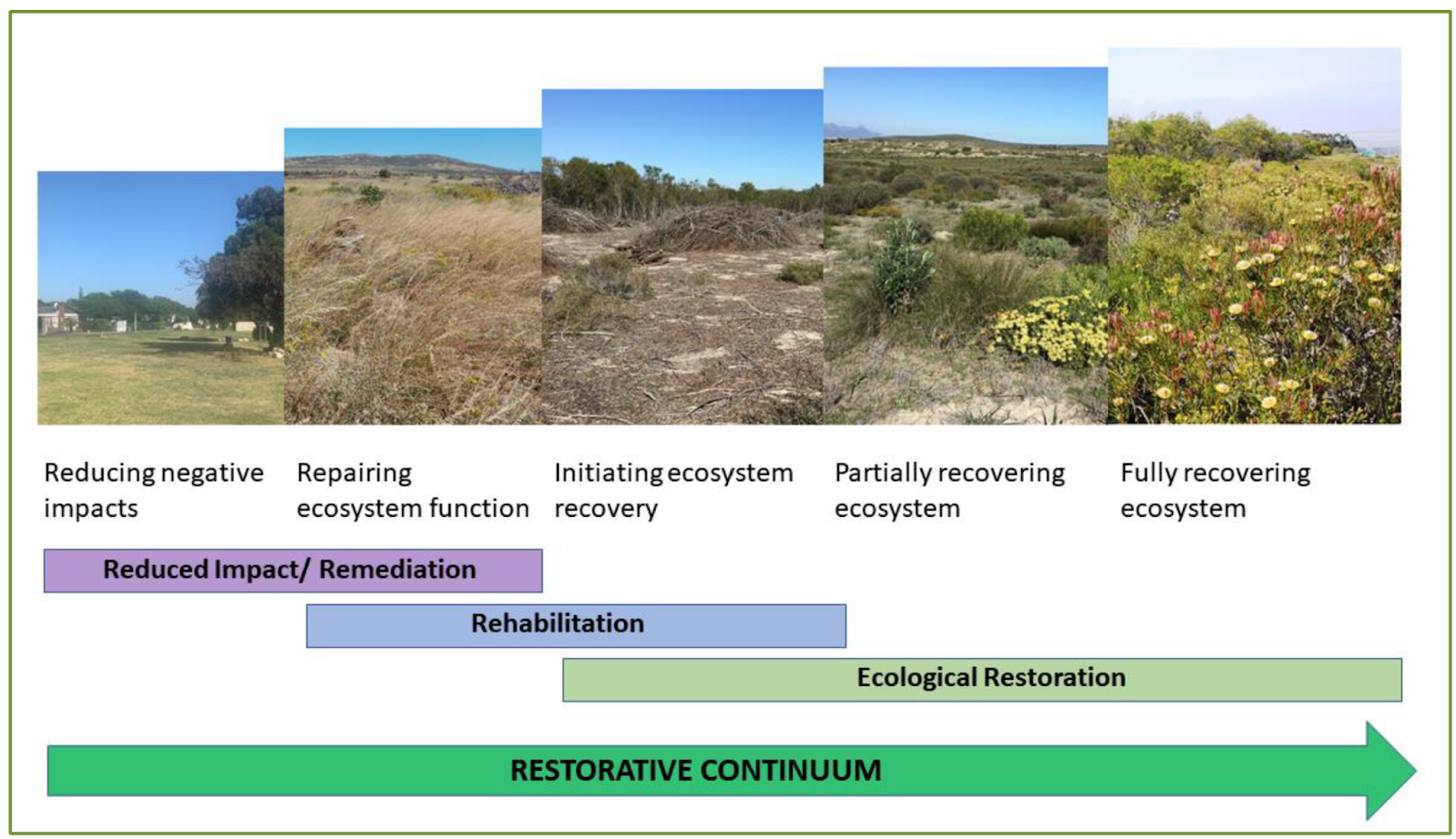
The process of restoration in Cape lowlands Fynbos. From Guidelines for Restoring Lowland Sand Fynbos Ecosystems by Holmes et al., 2022.
The best practices of restoration are still being worked out, but there is no doubt that ecosystem restoration is vital to the survival of many of Cape Town’s endemic plant and animal species. Restoration counteracts the ongoing expansion of human development into natural areas and the constant introduction of new invasive species. It is also important for Cape Town’s natural and cultural heritage, air and water quality, and mental wellbeing of its people.
Want to get more hands-on? Read our beginner’s guide to fynbos and indigenous gardening!
Sites of ecosystem restoration
Fortunately, the city has numerous successful restoration projects under its belt, all of which provide rewarding days out for those who want to see some of Cape Town’s most threatened flora and fauna.
Princess Vlei
Princess Vlei, near Grassy Park and Retreat in the southern suburbs, is one of the flagship restoration projects of the Cape Flats. This degraded wetland habitat was neglected for decades, despite its cultural significance and importance as a breeding site for the endangered Western Leopard Toad.
The significance of the vlei to its neighbouring communities was such that the community-run Princess Vlei Forum rallied to prevent the construction of a mall on its banks in 2014.

Princess Vlei before and after ecosystem restoration. Many indigenous Fynbos species have replaced the invasive grasses and weeds. Photos by Alex Lansdowne.
Beginning in 2018, the Princess Vlei Restoration Project has been active in reintroducing indigenous Fynbos species to the wetland area. The project will run until 2024, and the Princess Vlei Forum has organised several community- and volunteer-led mass planting events. There has also been a strong emphasis on education and ensuring local, impoverished communities feel a sense of ownership and stewardship for the land. It has been a successful collaboration between community non-profits, city government and the South African National Biodiversity Institute.
The Princess Vlei Restoration Project aims to restore three threatened vegetation types: Cape Lowlands Freshwater Wetlands (endangered), Cape Flats Dune Strandveld (endangered) and Cape Flats Sand Fynbos (critically endangered). Two particularly threatened plant species endemic to the Cape peninsula to be enjoyed here are the extinct in the wild Erica verticillata (whorled heath) and critically endangered Serruria foeniculacea (Rondevlei spiderhead). The vlei also attracts many native birds, and is home to numerous species of frogs and toads.
Serruria foeniculacea (Rondevlei spiderhead). Photo by iNaturalist user botanicexpedition2019nl-saf
More detailed information about the restoration process at Princess Vlei is available on the Society for Ecological Restoration website, including the various non-profit organisations involved and the management objectives, interventions and timelines. To volunteer at events see the Princess Vlei Forum.
Blaauwberg Nature Reserve
For those wanting to explore Fynbos restoration in the northern parts of Cape Town, the Blaauwberg Nature Reserve is an excellent choice. This is another reserve hosting the critically endangered Cape Flats Sand Fynbos vegetation type, which occurs on highly acidic, sandy soils in the flatter regions of the Cape peninsula.
Until recently, the land was covered by impenetrable thickets of the invasive Australian Port Jackson tree, Acacia saligna. It is one of the most aggressive and hard-to-remove invasive species in the Fynbos, as it is adapted to the nutrient-poor soils of the Cape and grows faster than native species, quickly outcompeting them for sunlight. Clearing the Port Jacksons and other invasives therefore required, and will continue to require, the hard labour of many volunteers and workers.
Extensive scientific research in this reserve conducted by professors and post-graduate students at Stellenbosch University has also improved our overall understanding of best practices for restoration of lowland Fynbos in the Cape, including the importance of fire and treatment of seeds prior to planting.

Pristine Fynbos in the foreground and invaded Fynbos in the background in the Blaauwberg Nature Reserve prior to restoration. Photo by Stuart Hall.
The reserve also provides a chance to see Swartland Shale Renosterveld vegetation. Renosterveld is a type of Fynbos occurring on relatively richer soils. The nutrients of these soils make it attractive to farmers, meaning much of this vegetation type has been lost to agriculture. Only 3% of its historic extent remains.
A view of Table Mountain from Blaauwberg Nature Reserve. Photo from Friends of Blauuwberg Conservation Area website.
Blaauwberg Nature Reserve offers unique views of Table Mountain and Robben Island, and over 600 plant species. A full list of the flora, organised by month, can be downloaded from the Friends of Blaauwberg Conservation Area website.
While the reserve has restored vegetation to enjoy throughout the year, the months of Spring are particularly rewarding to flower lovers. The reserve is at the southern end of the growing range for numerous West Coast plant species, making it a good stop for wildflower day trips up this coast.
Lower Tokai Park
I referred to Tokai Park in my last article on plant conservation in Cape Town, but it is equally relevant to the field of restoration.
Broadly speaking, ecological restoration can be split into active and passive restoration. Passive restoration involves removing the causes of degradation to a habitat as far as possible – such as removing invasive species, controlling pollution and limiting human disturbance – and allowing the native vegetation to recover by itself. This is possible when enough native plant seeds remain in the soil, or there are nearby natural areas that allow native plants to re-establish themselves in the restored area over time.
Active restoration involves the physical growing and planting of species that are no longer found in the restoration area, or that have diminished in number. Because Tokai was used as a pine plantation for over a century, many species had disappeared from the soil seedbank and thus required some active restoration. Fire-dependent species in particular were missing, as many of these species store their seeds in a cone until a fire occurs. For other species, however, passive restoration was sufficient as their seeds had survived in the soil under the pines.
Restored Fynbos in Lower Tokai Park, with the east side of Table Mountain and Devil’s Peak visible in the background. Photo by Tim Kirsten.
The restoration at Lower Tokai Park is ongoing, with several dozen individuals of threatened species being planted in June 2022. The park hosts wetland, Peninsula Granite Fynbos and Cape Flats Sand Fynbos vegetation, providing habitat for a variety of bird, reptile, amphibian and insect species. The area is also frequented by a troop of Chacma baboons.